Correct Lane Usage: Rules for Highways and Roads in Spain
Correct lane usage on highways and roads is one of the fundamental pillars of road safety. It is not simply a recommendation, but a legal obligation established in the General Traffic Regulations. Mastering these rules not only avoids financial penalties and loss of driving license points but, most importantly, saves lives. This article stands as the definitive and comprehensive guide for drivers who wish to travel safely, efficiently, and with full knowledge of the law.
Incorrect lane usage, especially the misuse of the left lane, is a recurring cause of accidents, traffic jams, and hazardous situations on high-capacity roads. According to data from the Directorate General of Traffic (DGT), approximately 30% of drivers do not use lanes in accordance with regulations on highways, a percentage that increases on conventional roads. This behavior not only slows down traffic but also generates frustration and dangerous maneuvers such as overtaking on the right. Understanding and applying the rules detailed below is, therefore, an act of collective responsibility.
Legal Foundations: The Regulatory Framework
The basis for lane usage in Spain is found in the General Traffic Regulations (RGC), specifically in Articles 28, 29, 31, and 32. These regulations implement the Road Safety Law and establish the rules of conduct for road users. It is essential that every driver knows this framework, as ignorance of the law does not exempt from compliance. Infractions related to improper lane use are considered serious or very serious, with penalties that can reach 500 euros and the deduction of points from the driving license.
For a global understanding of the legal context, it is essential to consult the complete guide on Traffic Regulations and Rules, where all aspects of the regulatory framework governing traffic in Spain are explained in depth.
Basic Principle: Driving on the Right
The guiding principle, established in Article 28 of the RGC, is clear: on roads with more than one lane per direction, one shall normally drive in the lane situated furthest to the right. This is not advice, but the default rule. The central lanes and, especially, the left lane (on roads with two or more lanes per direction) are intended exclusively for overtaking or for passing obstacles in the right lane. Once the overtaking maneuver is completed, the driver must return safely and progressively to the right lane.
Practical Example: Imagine you are driving on a three-lane highway. Your cruising speed is 110 km/h. You should start and maintain your journey in the right lane. If you encounter a truck traveling at 90 km/h, you can use the central lane to overtake it. Once you have passed it and left a sufficient safety distance, you will signal and return to the right lane. The left lane should only be used if, while in the central lane, you need to overtake another vehicle that is already overtaking.
The Left Lane: Usage, Prohibitions, and Common Misunderstandings
The left lane is, without a doubt, the one that generates the most confusion and incorrect behavior. Its use is strictly regulated:
- Permitted Use: Only for overtaking. It is not a lane for continuous driving at higher speeds.
- Express Prohibition: It is strictly prohibited to drive in the left lane when the right lane is free and can be used. Doing so constitutes a serious infraction.
- Speed is not Justification: Driving at the maximum permitted speed (for example, 120 km/h on a highway) does not grant the right to occupy the left lane if the right lane is free. The rule of driving on the right is independent of speed.
A common misunderstanding is believing that "if I'm going fast, I can drive on the left." This is false and dangerous. It forces other drivers to perform overtaking on the right (a prohibited and very dangerous maneuver) or to get too close to the vehicle ahead of them. The DGT frequently conducts specific surveillance campaigns to penalize the improper use of the left lane.
Specific Rules by Road Type
The general rules apply on all roads, but there are important nuances depending on the type of road.
On Highways and Motorways
These are high-capacity roads, segregated with independent roadways for each direction. They usually have two or three lanes per direction.
- Right Lane: Intended for normal traffic. This is the lane in which trucks, slow vehicles, and other users should drive when not overtaking.
- Central/Intermediate Lane/s: Primarily intended for overtaking. It can be used for continuous driving only if traffic is dense and the lanes are occupied, but the priority is always to return to the right when possible.
- Left Lane: Exclusive for overtaking. Never for continuous driving.
Speed is a crucial factor here. Consult our detailed guide on Speed Limits in Spain to know the maximum and minimum speeds permitted on each type of road, as driving at an abnormally reduced speed in the left lane is also an infraction.
On Conventional Roads (with a single lane per direction)
The dynamic changes. With only one lane for each direction, the rule of "driving on the right" within the roadway does not apply. However, the principle of occupying the right side of the road (relative to the direction of travel) remains valid. The key here is overtaking, which can only be performed by invading the opposite lane when visibility and safety conditions allow it. The rules on when and how to perform this maneuver safely are perfectly defined in our specialized article on Overtaking Rules.
In Urban Areas
In the city, with multiple lanes, the general rule of driving on the right also applies. However, it is permitted to occupy the lane most convenient for the destination, always with sufficient advance notice and performing lane changes with signaling. Left lanes in the city are usually intended for turning left or going straight, so their continuous use may be correct if that itinerary is to be followed.
Additional Lanes: HOV, Acceleration, and Deceleration
HOV Lanes (High-Occupancy Vehicle Lanes)
These are reserved lanes, normally the leftmost one, for vehicles with a minimum number of occupants (for example, 2 or 3 people, including the driver). Their use by vehicles that do not meet the requirement is severely penalized. Their objective is to encourage carpooling and reduce traffic congestion.
Acceleration Lanes
These are short lanes that allow merging onto a highway or motorway. The driver does not have priority. They must adjust their speed to that of the main road and yield, merging into the traffic flow when they can do so safely, normally into the right lane.
Deceleration Lanes
These are lanes for exiting the highway. One must signal in advance and change to the deceleration lane without abruptly reducing speed in the traffic lane. Once in it, adjust speed to take the exit.
Vehicles with Restrictions: Trucks, Vans, and Cars with Trailers
Heavy vehicles (with GVW > 3,500 kg) and vehicle combinations longer than 7 meters are prohibited from driving in the left lane on highways and motorways with more than two lanes per direction. On three-lane roads, they may only use the two lanes situated furthest to the right. This rule aims to improve flow and safety, preventing slow vehicles from blocking lanes intended for overtaking.
| Vehicle Type | Permitted Lanes (3-lane Highway) | Specific Prohibitions |
|---|---|---|
| Passenger Car/Motorcycle | All (right for driving, others for overtaking) | Driving in left lane with right lane free |
| Truck (>3500 kg) | Only right and central lanes | Left lane prohibited |
| Car with trailer (>7m) | Only right and central lanes | Left lane prohibited |
| Van (<3500 kg) | All (same rules as passenger car) | Driving in left lane with right lane free |
Special Situations and Practical Cases
Dense Traffic or Traffic Jams
In conditions of high traffic density where all lanes are occupied, driving in any lane is permitted. However, the principle of efficiency remains valid: if the right lane flows faster, it is the one that should be used. The "accordion effect" and traffic jams are often aggravated by poor distribution of vehicles in the available lanes.
Driving in Adverse Weather Conditions
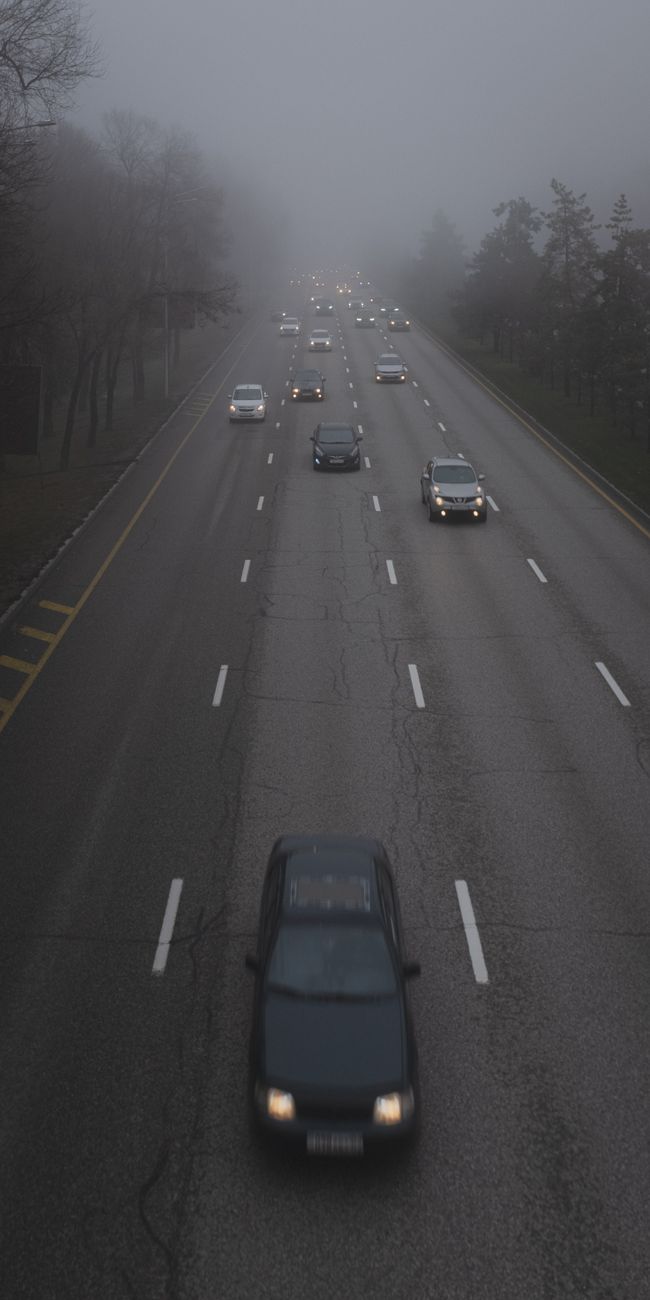
With rain, fog, or ice, the rule of driving on the right is reinforced. The left lane, being the closest to the center of the roadway, often accumulates more water (aquaplaning) and is more dangerous. Furthermore, safety distance must be increased and speed reduced, making it even more necessary to free the left lane for those who, with extreme caution, need to overtake.
Mini-Case: Multiple Overtaking
Situation: You are driving on a two-lane highway. In the right lane, there is a line of three trucks. A passenger car positions itself in the left lane and overtakes all three at once. Is this correct? Yes, as long as during the entire maneuver it does not obstruct another vehicle traveling in the left lane at a higher speed. They are not obligated to intercalate between trucks. However, if during the overtaking they see in the rearview mirror another vehicle approaching quickly from the left, they must assess whether they can finish their maneuver without putting it at risk or if it is preferable to accelerate slightly (without exceeding the limit) or, as a last resort, abort the overtaking and rejoin the right to yield. Courtesy and safety take precedence over the strict rule.
Priorities and Conflicts in Lane Changes
When changing lanes, the driver performing the maneuver must always yield to vehicles traveling in the lane they intend to enter. There is no priority for having the turn signal on. Signaling (turn signal) is a notice of intention, not a right of way. Coordination and respect for Right of Way are essential for performing fluid and safe lane changes. A common mistake is forcing the merge expecting others to brake.
Consequences of Non-Compliance: Penalties and Risks
Infractions related to improper lane use are not trivial. According to the RGC:
- Driving in the left lane without justified cause: Serious infraction. Penalty of 200 euros.
- Driving in the left lane seriously obstructing others: Serious infraction. Penalty of 200 euros and possible point deduction.
- Overtaking on the right (except in rare exceptions such as dense traffic or a vehicle turning left): Serious infraction. Penalty of 200 euros and 4 license points.
- Not respecting priority in a lane change: Serious infraction. Penalty of 200 euros.
Beyond the fine, the real risk is causing accidents. A stopped or slow vehicle in the left lane is an unexpected obstacle for someone traveling at overtaking speed. Rear-end collisions under these circumstances are usually of great severity.
Summary and Conclusions: Keys for Correct and Safe Use
Correct lane usage is synonymous with efficient, fluid, and, above all, safe driving. To internalize these rules, follow these action principles:
- Right is the Default: Your habitual lane is always the one furthest to the right. Get used to returning to it after each overtaking.
- Left is Only for Overtaking: Consider the left lane as a "temporary maneuver zone," not as a fast lane.
- Anticipate and Signal: Plan your lane changes in advance, always signal them, and respect the priority of those already traveling in the destination lane.
- Adapt Your Behavior to the Road Type: Know the differences between highway, conventional road, and urban road.
- Be Courteous and Foresighted: Driving is a social activity. Observe your surroundings through the mirrors, anticipate the actions of others, and facilitate traffic flow whenever it is safe to do so.
Mastering lane usage is not just about avoiding penalties; it is a commitment to one's own safety and that of all road users. Orderly and predictable traffic reduces stress behind the wheel, travel times, and, most importantly, the probability of suffering an accident. Turn these rules into an automatic habit and you will contribute to safer mobility for everyone.