Overtaking Rules: Complete Guide to Performing It Safely
Overtaking is one of the most common maneuvers in driving, but also one that presents the greatest risks if not performed correctly. According to data from the General Directorate of Traffic (DGT), approximately 15% of serious road accidents are related to poorly executed overtaking. This comprehensive guide aims to provide drivers with the necessary knowledge to perform overtaking safely, efficiently, and in accordance with current regulations.
Understanding overtaking rules is not only essential for passing the driving test, but it constitutes a vital skill for daily road safety. A correct overtaking requires an accurate assessment of multiple factors: visibility, distance, speed, and the behavior of other road users. Throughout this article, we will explore in depth when overtaking is allowed, how to do it safely, and the situations in which it is strictly prohibited.
Legal Fundamentals of Overtaking
Overtaking is regulated in the General Traffic Regulations, specifically in articles 82 to 89. These provisions establish the basic conditions that every driver must meet to perform this maneuver legally. The regulations define overtaking as the maneuver by which one vehicle passes another traveling in the same direction and in the same lane, or in a different lane but within the same roadway.
It is crucial to differentiate between overtaking and passing. While overtaking involves changing lanes to pass another vehicle, passing occurs when you pass a vehicle without leaving the lane you are traveling in, such as when there are multiple lanes in the same direction. This distinction is fundamental for correctly applying the specific rules for each situation.
For a more complete understanding of the regulatory framework, we recommend consulting our guide on Traffic Regulations and Rules: A Complete Guide, which details all the legal provisions affecting road traffic.
Prerequisites for Overtaking
Before initiating any overtaking maneuver, the driver must meticulously verify three fundamental conditions: visibility, distance, and speed. The absence of any of these conditions makes overtaking a dangerous and potentially illegal maneuver.
Visibility is the most critical factor. The driver must have a clear and sufficient view of the road ahead, ensuring that no vehicle is approaching from the opposite direction and that there are no obstacles that could compromise the maneuver. On conventional roads, a minimum visibility of 200 meters on straight sections is recommended, although this distance may vary depending on speed and road conditions.
Safety distance is another crucial element. An adequate distance must be maintained with the vehicle to be overtaken, generally equivalent to the distance traveled in 2 seconds. This separation allows sufficient time to react if the preceding vehicle unexpectedly changes its trajectory or speed.
Regarding speed, the overtaking vehicle must be able to develop a speed significantly higher than that of the vehicle being overtaken, so that the maneuver is completed in the shortest possible time and without forcing vehicles traveling in the opposite direction to reduce speed. Insufficient speed difference can dangerously prolong the time spent in the opposite lane.
Step-by-Step Procedure for Safe Overtaking
Performing a safe overtaking requires following a strict protocol that minimizes risks. This process is divided into four clearly differentiated phases: preparation, execution, return, and completion.
Preparation Phase
In this initial phase, the driver must thoroughly evaluate the situation. First, verify that there is no signage prohibiting overtaking in that section. Second, check the rearview mirrors to ensure that no vehicle is attempting to overtake in turn. Third, signal the intention to overtake using the left turn signal with sufficient advance notice, generally at least 5 seconds before initiating the maneuver.
Execution Phase
Once safety conditions are confirmed, the lane change to the left begins (in countries with right-hand traffic). It is essential to perform this movement progressively but decisively, maintaining a straight trajectory parallel to the roadway. During movement in the opposite lane, a constant speed higher than that of the vehicle being overtaken should be maintained, avoiding sudden accelerations that could destabilize the vehicle.
Return Phase
The moment to return to the original lane is particularly delicate. It should only be done when the overtaken vehicle is completely visible in the central rearview mirror, indicating that a sufficient safety distance has been left. An additional practical rule is to wait until you see both headlights of the overtaken vehicle in the rearview mirror. Before changing lanes, signal with the right turn signal.
Completion Phase
Once reintegrated into the lane, speed should be maintained or slightly increased to not obstruct the overtaken vehicle. It is advisable not to reduce speed abruptly after overtaking, as this could surprise the driver behind.
Situations Where Overtaking is Prohibited
The General Traffic Regulations establish specific circumstances in which overtaking is strictly prohibited. Knowing these prohibitions is essential for both road safety and passing the driving test.
First, overtaking is prohibited at railroad crossings, intersections, and their vicinity, unless there is a lane specifically designated for it. Overtaking is also not allowed at changes in gradient with reduced visibility, tunnels, underpasses, and road sections with express prohibition signage.
Another important prohibition applies when driving behind a school bus or a vehicle transporting minors that is stopping for passenger pickup or drop-off. Similarly, it is prohibited to overtake cyclists or pedestrians in groups when they are traveling on the roadway, unless a minimum lateral separation of 1.5 meters can be left.
On highways and freeways, although they generally allow overtaking on the left, there are specific restrictions. For example, overtaking on the right is prohibited, except when the vehicle ahead is indicating its intention to turn left and there is sufficient space.
Overtaking in Special Conditions
Adverse weather conditions or particular road situations require specific adaptations in overtaking techniques. In these cases, the safety margin must be considerably expanded.
Overtaking in Rain or Fog
With heavy rain, visibility is drastically reduced and vehicle traction decreases. Under these conditions, overtaking should only be considered when strictly necessary and with exceptionally good visibility. The safety distance should be increased by at least 50%, and the maneuver should be performed with extreme smoothness in steering movements.
With fog, overtaking is practically contraindicated. Reduced visibility and the possibility that other vehicles may not have their lights on make this maneuver extremely dangerous. If overtaking in fog is absolutely essential, it must be done with low beam lights on (never high beams, which create a mirror effect) and at a very reduced speed.
Overtaking on Curves and Changes in Gradient
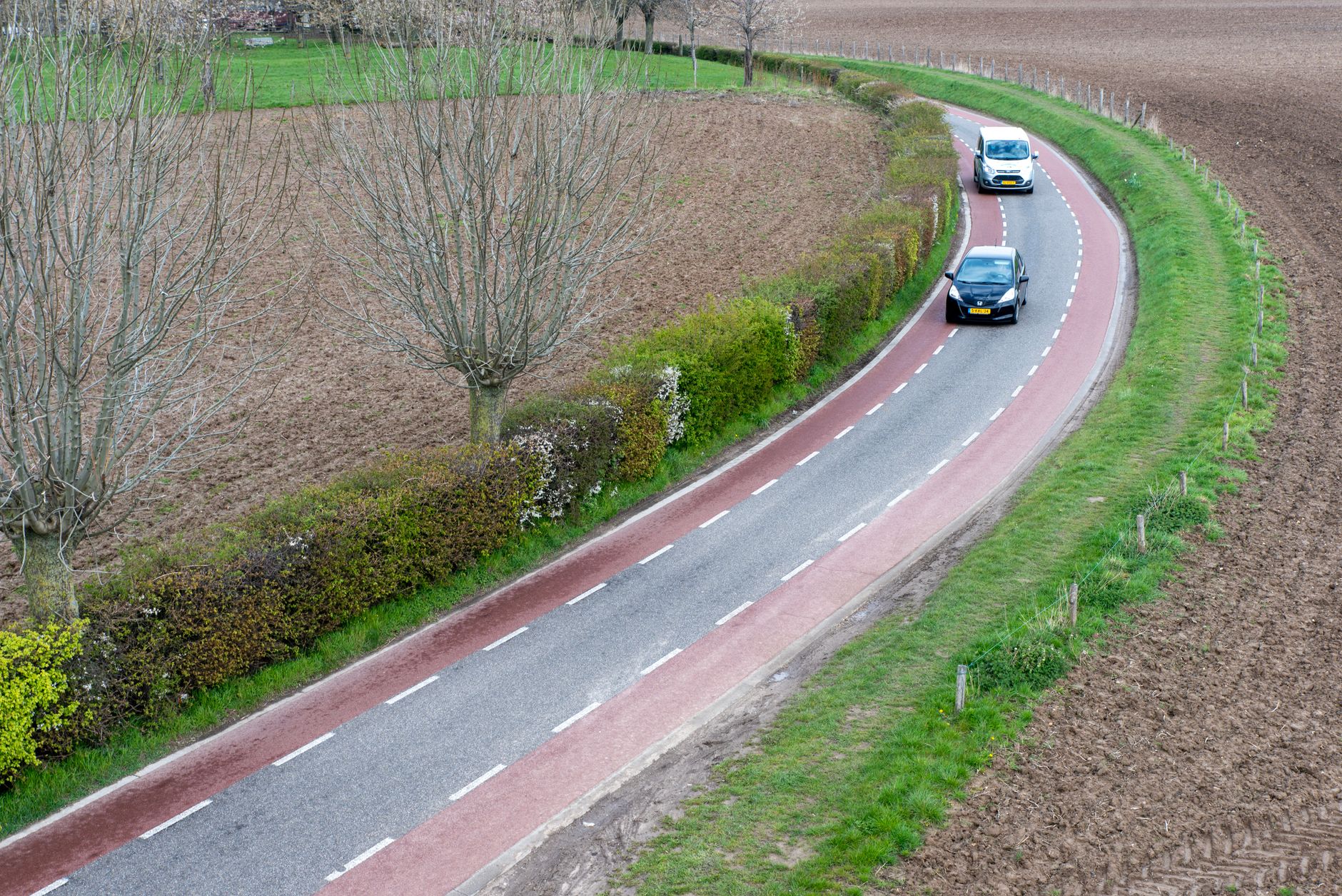
On curves, visibility is limited, so overtaking is only safe when the curve is very wide and there is a broken continuous line that allows it. On changes in gradient, the prohibition is absolute when there is insufficient visibility of the roadway beyond the change.
Overtaking Special Vehicles
Large vehicles (trucks, buses) present particular challenges. Their length creates significant blind spots, and the slipstream effect they generate when overtaking them can affect vehicle stability, especially with crosswinds. When overtaking these vehicles, it is crucial to ensure that the driver has perceived our presence, maintain a clearly higher speed to minimize exposure time to the slipstream effect, and leave generous lateral separation.
Signage Related to Overtaking
The road signage system includes specific signs that regulate overtaking. Knowing and correctly interpreting these signs is fundamental for safe and legal driving.
Overtaking prohibition signs (R-305) feature two concentric circles, red on the outside and white on the inside, with two overlapping black cars. They indicate that overtaking motor vehicles is prohibited, except for two-wheeled motorcycles, in the section where they are placed. Their end is indicated by the R-306 sign, which shows the same image crossed out with a black diagonal line.
Overtaking prohibition signs for trucks (R-307) are similar but include the silhouette of a truck. They specifically prohibit trucks and vehicle combinations over 3,500 kg from overtaking motor vehicles in the indicated section.
In addition to vertical signs, road markings also regulate overtaking. A continuous line on the roadway centerline indicates an absolute prohibition of overtaking, while a broken line allows it when safety conditions advise it. Mixed lines (continuous on one side and broken on the other) indicate that only vehicles traveling on the side of the broken line may overtake.
Statistics and Relevant Data on Overtaking
Understanding the real dimension of the risk associated with overtaking requires analyzing statistical data. According to the latest DGT report on accidents, incorrect overtaking represents a significant cause of serious accidents.
| Type of Incident | Percentage of Serious Accidents | Main Factor Identified |
|---|---|---|
| Overtaking with insufficient visibility | 42% | Distance calculation error |
| Overtaking on curves or changes in gradient | 28% | Ignorance of prohibitions |
| Overtaking at inadequate speed | 18% | Insufficient speed difference |
| Overtaking without maintaining distance | 12% | Lack of safety space |
These data reveal that calculation errors and ignorance of prohibitions are the most frequent factors in overtaking accidents. The high percentage of accidents due to insufficient visibility is particularly concerning, which could be avoided with a more conservative assessment of road conditions.
Studies by the MAPFRE Foundation add that approximately 60% of drivers admit to having performed overtaking in questionable safety conditions, and 25% admit to having overtaken in places where it was prohibited. These risky behaviors highlight the need for continuous training on this maneuver.
Practical Tips from Road Safety Experts
Driving instructors and road safety experts agree on several practical recommendations for performing safe overtaking. These suggestions go beyond what is strictly regulated, incorporating the accumulated experience of years of driver training.
The first universal advice is "when in doubt, do not overtake." Prudence should always prevail over haste. If there is any uncertainty about visibility, distance, or speed conditions, it is preferable to maintain position and wait for a safer opportunity.
Experts also recommend using the "three-second" rule to evaluate the safety of an overtaking: one second to decide, one second to prepare the maneuver, and one second to execute it. If any of these seconds is compromised by adverse conditions, the overtaking should be aborted.
Regarding technique, the importance of keeping both hands on the steering wheel throughout the overtaking, avoiding distractions such as adjusting the radio or climate control, and not fixing your gaze exclusively on the vehicle being overtaken, but constantly scanning the road ahead, is emphasized.
Practical Case: Analysis of an Overtaking on a Conventional Road
To illustrate the practical application of all the previous rules and recommendations, let's analyze a specific case. Imagine a conventional road with one lane per direction, with a broken centerline, clear weather, and moderate traffic. We are traveling at 80 km/h behind a truck going 70 km/h. We want to overtake it.
First, we verify that there is no signage prohibiting overtaking. We observe the section ahead: it is straight, with good visibility of at least 300 meters, and we see no vehicles approaching from the opposite direction. We check the rearview mirrors and detect no vehicles attempting to overtake us.
We activate the left turn signal approximately 5 seconds in advance. We slightly reduce the distance with the truck to prepare for overtaking, maintaining the 2-second safety distance. When we confirm that conditions remain safe, we change to the opposite lane, accelerating progressively until reaching 90 km/h.
During the overtaking, we maintain a straight trajectory parallel to the truck, constantly monitoring the road ahead in case of any unforeseen event. When we see the truck completely in the central rearview mirror and both of its headlights, we activate the right turn signal and smoothly return to our lane.
Once reintegrated, we maintain the speed of 90 km/h for a few seconds before adjusting it to the road limit. This case exemplifies an overtaking performed in accordance with all safety rules, demonstrating the practical application of theoretical principles.
Relationship with Other Traffic Rules
Overtaking does not exist in a regulatory vacuum but is interrelated with other traffic regulations. Understanding these connections is essential for a comprehensive view of road safety.
The most direct relationship is with speed limits in Spain: rules by road type and zone. The speed during overtaking must be adapted not only to the necessary difference with the vehicle being overtaken but also to the maximum limit allowed on that road. Overtaking while exceeding the speed limit constitutes a serious infraction, regardless of how the maneuver is performed.
Another important connection is with the rules of right of way: how to determine who has priority. At intersections and roundabouts, right-of-way rules can substantially modify the safety of an overtaking. For example, overtaking a vehicle that is yielding at an intersection can create risky situations if it is not properly understood who has priority at that moment.
Overtaking Assistance Technologies
Technological advances have introduced driver assistance systems that can significantly improve safety during overtaking. Knowing these technologies helps drivers use them effectively.
The Blind Spot Information System (BLIS) detects vehicles in the driver's blind spots and emits a light signal in the corresponding mirror. This technology is particularly useful during the preparation phase of overtaking, alerting about vehicles that might be attempting to overtake simultaneously.
The overtaking assistant is a more advanced technology that analyzes multiple parameters (own speed, speed of the preceding vehicle, speed of oncoming vehicles, available distance) and recommends the optimal moment to initiate the maneuver. Some systems can even temporarily take control of the vehicle to perform the overtaking automatically when the driver confirms the intention.
Although these technologies are valuable, experts emphasize that they do not replace driver responsibility. Human judgment remains fundamental for evaluating complex situations that sensors may not interpret correctly.
Conclusion and Final Recommendations
Overtaking is a maneuver that, when performed correctly, contributes to traffic flow and travel efficiency. However, when executed incorrectly, it becomes one of the main causes of serious road accidents. This comprehensive guide has covered all essential aspects: from legal fundamentals to practical techniques, including prohibition situations and special conditions.
Statistics show that the most common errors in overtaking are calculation errors: underestimating the necessary distance, overestimating the available speed, or misinterpreting visibility conditions. Against these errors, the best defense is a prudent and methodical attitude, always applying the principle of "better late than never."
For aspiring drivers, mastering overtaking rules is crucial not only for passing the driving test but for developing safe driving habits that will last a lifetime. For experienced drivers, periodically reviewing these rules helps correct bad habits that may have been acquired over time.
Let's remember that each overtaking is a decision that affects not only our safety but that of all road users. Performing it correctly is a demonstration of responsibility, skill, and respect for coexistence on the roads.