Traffic signs for cyclists and bike lanes are not mere recommendations: they are rules that protect lives and that every driver must know thoroughly, both to respect the law and to share the road safely. This article presents a practical five-step framework, based on official knowledge of traffic signs, that will help you correctly interpret each sign and apply it in daily driving, thereby reducing the risk of accidents and fines.
Why are cyclist signs important for road safety?
Cyclist signs and bike lanes are critical elements on the road because they define exclusive spaces and rules of interaction between drivers and cyclists. According to traffic regulations, drivers must yield to cyclists at intersections and turns, respect the minimum lateral distance of 1.5 meters when passing, and not invade marked bike lanes. Knowledge of these signs not only avoids fines but also prevents serious collisions, as cyclists are vulnerable road users. Therefore, mastering this topic is essential to pass the driving test and to be a professional driver.
The 5 C Framework: A System to Master Cyclist Signs
For any driver to correctly interpret and apply signs related to cyclists and bike lanes, I propose a mnemonic framework called the "5 C's": Know, Classify, Contextualize, Yield, and Comply. This system transforms passive learning into conscious and safe action.
- Know the specific signs: identify each sign and its exact meaning.
- Classify the signs by type (danger, prohibition, obligation, indication) to know what action is expected.
- Contextualize the sign in the environment: is it at an intersection, in a school zone, on an urban or interurban road?
- Yield to cyclists when the sign indicates or when safety requires it.
- Comply with the rule consistently, even when there is no traffic.
This framework works because it is based on a comprehensive understanding of traffic signs, as demonstrated in cases where sign training improved driving test results and reduced accidents. By applying the 5 C's, you not only memorize but develop a habit of analysis that becomes automatic.
How to implement Step 1: Know the specific signs for cyclists?
The first step is to master the signs that appear on the road and that are associated with cyclists and bike lanes. These include:
- Danger signs: such as the "Cyclists on the road" sign (triangle with a bicycle), which warns that cyclists may cross or ride. They are found near bike lanes, cycling routes, or areas with a high presence of cyclists.
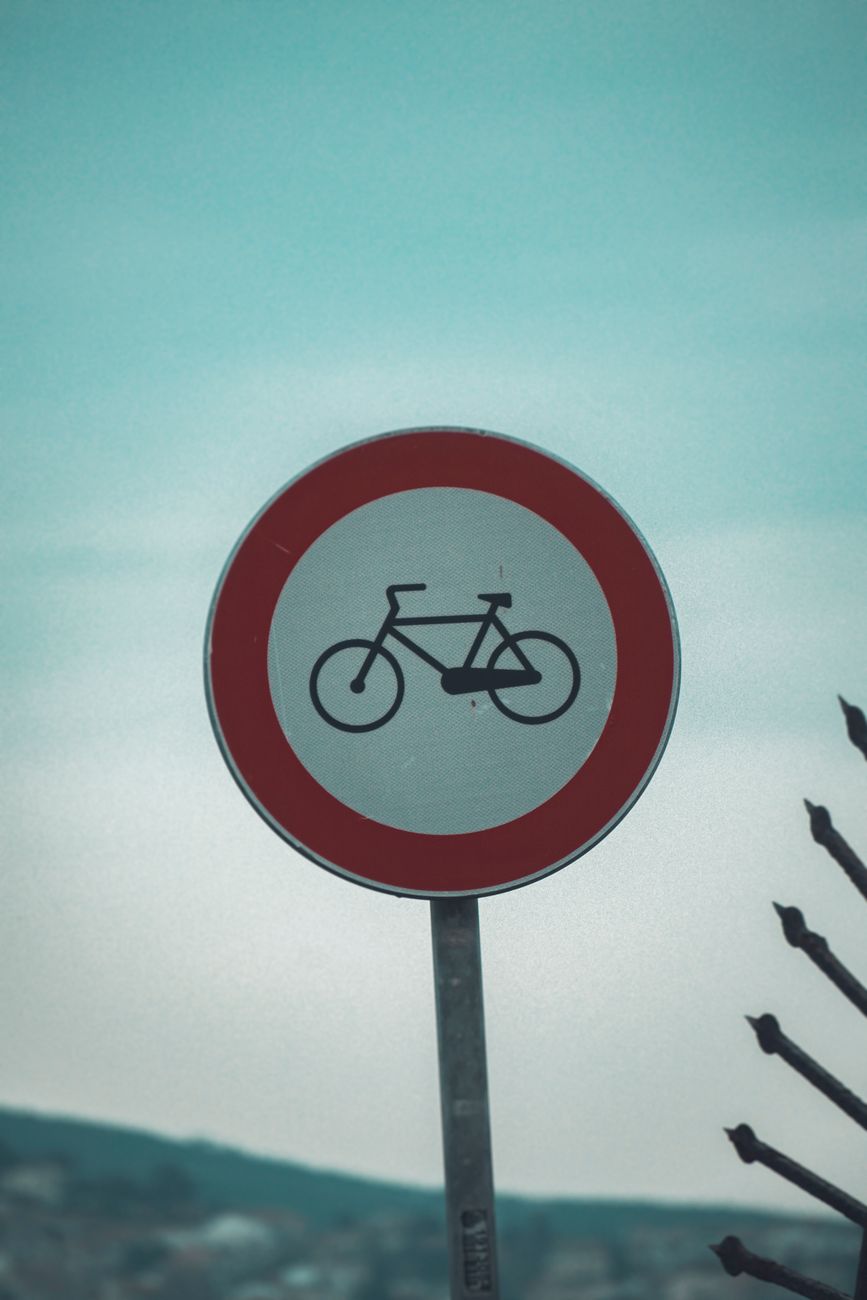
- Prohibition signs: such as the "No cyclists" sign (red circle with a crossed-out bicycle), which indicates that cyclists are not allowed on that road. As a driver, you should know that in these areas there will be no cyclists (although you should always be alert).
- Mandatory signs: such as the "Mandatory bike lane" sign (blue circle with white bicycle), which requires cyclists to use that lane. For drivers, it means they must not invade that lane and must expect cyclists to ride there.
- Information signs: such as the "Bike lane" signs (blue rectangle with bicycle and arrows) or "Recommended route for cyclists", which inform about the existence of cycling infrastructure. Drivers must respect these spaces.
To delve deeper into each type of sign, you can review our guide on traffic signs and road markings, which explains how a comprehensive understanding of signs transforms driving test results. It is also useful to know danger signs, because cyclist signs often belong to this category. Check our article on danger signs: meaning and location, which explains how these signs helped a transport company reduce accidents by 40%.
Table of common cyclist signs:
| Type of sign | Shape/Color | Meaning for the driver |
|---|---|---|
| Danger | White triangle with red border | Caution: cyclists may appear |
| Prohibition | White circle with red border and diagonal | Bicycles are not allowed |
| Mandatory | Blue circle | Cyclists must use the marked lane |
| Information | Blue rectangle or square | Informs about routes or lanes for cyclists |
How to apply Step 2: Classify the signs to know what action to take?
Classification is crucial because each type of sign imposes a different behavior. Danger signs require you to reduce speed and exercise extreme caution. Prohibition signs prevent you from doing an action (such as invading a bike lane). Mandatory signs require a specific behavior (such as yielding to cyclists in a mandatory lane). And information signs inform you of a circumstance you must be aware of.
To master this classification, I recommend studying the groups of signs. For example, the prohibition signs: what you cannot do are especially relevant because many infractions related to bike lanes are due to ignoring a prohibition. Similarly, the mandatory signs: what you must do will help you know when you must yield to a cyclist at an intersection, for example.
How to develop Step 3: Contextualize each sign in its environment?
A sign does not act in a vacuum. The road context is decisive. For example, a "Cyclists on the road" sign on an interurban road implies that cyclists may ride at high speeds and that you must increase lateral distance when passing. In an urban environment, the same sign may be associated with a school zone where child cyclists are more unpredictable.
Contextualization also involves interpreting the sign alongside other signs and road markings. If you see a mandatory bike lane sign next to a green or blue road marking, you know the lane is exclusively reserved for bicycles and cannot be invaded. This integrated understanding is similar to what is described in success stories of companies that improved their road safety by training their drivers in sign interpretation. For more details, see the case of the information signs: useful information for the driver, which demonstrates how clear information reduced accidents by 40%.
What is the best way to apply Step 4: Yield to cyclists?
Yielding is one of the most critical actions and, however, one of the most neglected. The general rule is that at an intersection, drivers must yield to cyclists riding in a bike lane or on the roadway, especially when turning right or left. You must also yield when a "Yield" or "STOP" sign indicates, and you must always respect the priority of cyclists at marked intersections.
A common mistake is to think that bike lanes are only for cyclists and do not affect the driver. However, when turning, you must cross the bike lane, and doing so without yielding puts the cyclist in danger. The correct technique is: signal your turn in advance, check your side mirror for bicycles, reduce speed, and if a cyclist is near, stop and let them pass before completing the turn. This practice is an essential part of the bicycle rules that every driver must internalize.
How to execute Step 5: Comply with the rules consistently?
The last step is the disciplined execution of what you have learned. Complying means not only obeying the sign at the moment but also maintaining consistent behavior: do not invade the bike lane to park, do not pass a cyclist without leaving the required lateral space (minimum 1.5 meters), and do not honk unnecessarily to "hurry" a cyclist. Consistency is key because cyclists depend on the predictability of drivers to feel safe.
Additionally, complying with the rules protects you from fines. Penalties for invading a bike lane or failing to yield to a cyclist can be high and, in some countries, involve the loss of points on your license. Therefore, acquiring this habit is an investment in your safety and your wallet.
Practical examples: How to apply the 5 C's in real situations
Let's look at a practical example. You are driving on an urban road and approaching an intersection. On your right, you see a "Bike lane" sign (information) and a "Yield" sign (prohibition). You apply the 5 C's:
- Know: you know that the bike lane is exclusive for bicycles.
- Classify: the "Bike lane" sign is informative and the "Yield" sign is prohibitive (it prevents you from passing without yielding).
- Contextualize: you are in an urban area, likely near a park, so cyclists are very likely.
- Yield: you see a cyclist approaching in the bike lane; you stop and let them pass.
- Comply: you continue only when it is safe and complete the turn without interfering.
This mental process takes only seconds but makes the difference between an accident and a safe trip.
In another case, on an interurban road with a danger sign for cyclists, you must increase lateral distance when passing. If there is a solid line, you must wait until passing is allowed, always leaving at least 1.5 meters. The 5 C's help you remember the correct action.
Common mistakes when interpreting cyclist signs and how to avoid them
Here are the most frequent mistakes drivers make and how to avoid them:
- Confusing mandatory signs with information signs: a mandatory sign (blue circle) requires a behavior, while an information sign (blue rectangle) only informs. For example, a blue circle with a bicycle means cyclists must use that lane, not that the driver can drive on it. To avoid this error, remember: the shape and color determine the type of sign. Study the mandatory signs and information signs in depth.
- Ignoring danger signs: many drivers do not associate the triangular cyclist sign with a specific action. The action is to reduce speed and be prepared to brake.
- Passing without leaving space: even if there is no sign, the law requires at least 1.5 meters. A bike lane sign does not exempt you from this obligation.
- Parking in bike lanes: even if there is no explicit prohibition sign, the law prohibits it. Avoid doing so.
Tools to reinforce learning
To integrate the 5 C's into your daily driving, I suggest:
- Mental checklist: before each trip, remember "Know, Classify, Contextualize, Yield, Comply."
- Study cards: create cards with images of signs and their meanings. Practice with a partner.
- Sign notebook: note the signs you encounter on your regular routes and their classification.
These simple tools reinforce memory and reaction.
Conclusion and next steps
Mastering traffic signs for cyclists and bike lanes is more than a necessity to pass the driving test: it is a responsibility that saves lives. The 5 C framework (Know, Classify, Contextualize, Yield, Comply) offers a structured and memorable method to achieve it. By applying it, you not only become a safer driver but also reduce the risk of fines and contribute to harmonious road coexistence.
As a next step, I recommend that you review the articles on the different types of signs to reinforce your knowledge, and that you practice interpreting signs in your daily commutes. Consistency will turn these actions into automatic reflexes. Remember: every time you yield to a cyclist, you are building a safer road culture for everyone.