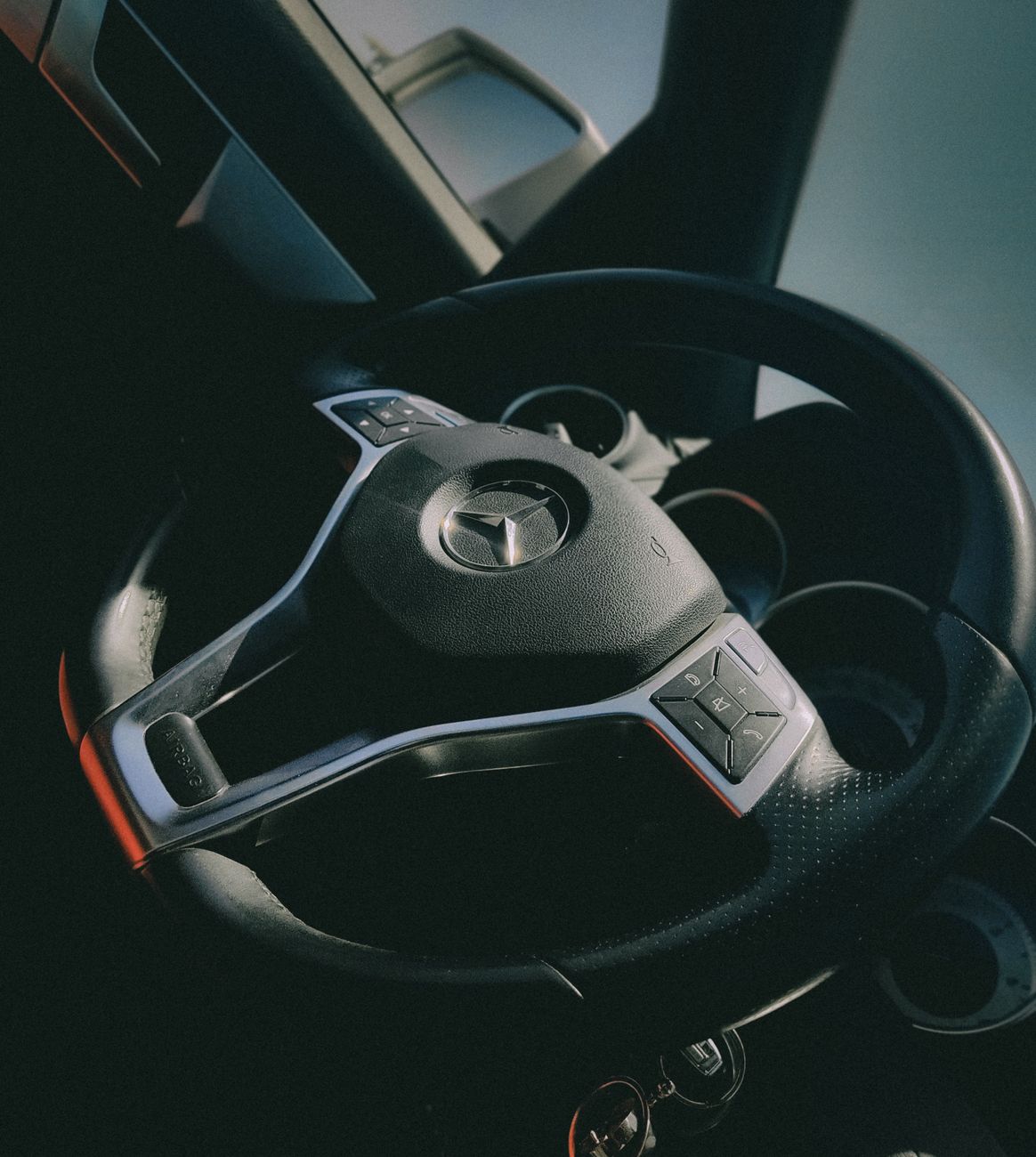
Mastering Power Steering: Steering Wheel Grip and Return Techniques in Slow Maneuvers
Mastering power steering in slow maneuvers depends on three elements: a firm but relaxed grip on the steering wheel at the 9 and 3 o'clock position (or 10 and 10), controlled return of the wheel after each turn, and avoiding unsafe habits such as letting go of the rim or crossing hands. These techniques reduce the risk of loss of control and increase precision in tight spaces.
Executive Summary
This document analyzes steering wheel grip and return techniques in slow maneuvers, with special attention to vehicles equipped with power steering. Based on technical sources and driving manuals, it establishes that the position of the hands on the steering wheel rim — traditionally described as "10 and 10" or "9 and 3" — determines precision in turns and parking, as well as the ability to react to the steering return effect.
A recurring problem is identified: many drivers acquire the habit of pressing the steering wheel with the palm of the hand to make quick turns, a practice that, while facilitated by power steering, compromises safety by reducing control and exposing the driver to a sudden steering wheel return. To address this, a structured approach is proposed based on symmetric grip, accompanying the turn without crossing arms, and controlled return to the initial position.
The implementation of these techniques in preparation for the driving exam allows the candidate to demonstrate vehicle control, anticipation, and mastery of power steering, factors evaluated in practical tests. The document concludes with an implementation guide and a checklist for instructors and drivers.
Introduction: Why does steering wheel mastery remain a critical skill in the era of power steering?
Power steering has transformed the driving experience: it reduces the physical effort needed to turn the steering wheel, especially at low speeds. However, this comfort does not eliminate the need to master technique. On the contrary, it can create a false sense of control that leads to unsafe habits.
In slow maneuvers — parallel parking, U-turns, reversing in tight spaces — precision is more important than speed. Driving manuals insist that "the slower you can move, the more precision you achieve." This maxim applies both to daily driving and to the practical evaluation of the driving exam.
The objective of this whitepaper is to provide a technical framework for steering wheel grip and return, based on evidence from manuals and practical classes. It addresses questions such as: what is the correct hand position? How should the steering wheel be turned without crossing arms? What risks does letting go of the rim entail? And, above all, how can these techniques be integrated into preparation for the driving exam?
Problem Statement: What incorrect habits persist in slow maneuvers and why are they dangerous?
Despite the spread of basic techniques, inadequate practices persist. One of the most cited is pressing the steering wheel at one point on the rim and rotating it to achieve quick turns. According to the technical source, "this maneuver is easier with power steering, but it does not offer safety because, since the steering wheel is not held, pressure can be reduced and it can return suddenly with the risks of loss of control that this entails."
The problem is not minor: in a slow maneuver, a sudden return can cause the vehicle to move more than desired, encroaching on a lane, a curb, or an obstacle. In addition, the driver who does not have both hands on the rim loses immediate reaction capability.
Another widespread habit is putting hands inside the circle of the rim. The manual warns that this "makes turns difficult and also entails risks of physical injury due to the steering return effect." Power steering, by reducing effort, can mask the force with which the steering wheel returns if released in an inadequate position.
Finally, many drivers maintain excessive tension in their arms. The practical class points out that one should "keep the steering wheel firm, but smooth, making turns without tension." Excessive tension reduces sensitivity and tires the driver, which affects precision in prolonged maneuvers.
In-Depth Analysis
What is the correct hand position on the steering wheel rim?
The recommended position varies slightly between sources, but they converge on symmetry. One source indicates that "the ideal position of the hands on the steering wheel rim [corresponds] to the clock hands" and that from this position turning maneuvers are facilitated, both for curves and for parking. The same source specifies: "When straight, the right and left hands are in the ten and ten position on the steering wheel rim, 0l and 0r."
Another source, oriented toward practical teaching, insists on gripping "with both hands, at 9 and 3 on the clock." The difference between "10 and 10" and "9 and 3" is minimal and responds to ergonomics and instructor preference. The essential thing is that both hands are on the rim, in a position that allows turning in both directions without crossing the arms.
The symmetric position serves three functions: (1) it allows balanced force to be applied, (2) it facilitates controlled return after a turn, and (3) it reduces the risk of airbag injuries in the event of a collision. In the context of the driving exam, the evaluator observes whether the candidate keeps their hands in the correct position throughout the route, including slow maneuvers.
How should the steering wheel be turned in slow maneuvers without crossing the arms?
The practical driving manual describes the procedure for turning right: "the hand on the same side should be placed at the top of the steering wheel, while the left hand should accompany the movement without letting go until it is located at that top part." In other words, a coordinated movement occurs: the right hand goes up and turns, the left accompanies.
A technical source details the sequence for a right turn:
- The left hand does not move (0l) and the right hand moves to the top of the steering wheel (1r).
- The right hand turns the steering wheel as far as it can without forcing (2r).
- If more turning is needed, the left hand continues the turn (3l) and the right hand changes position by turning more if necessary (4r).
This method avoids crossing the arms. The manual is emphatic: "The hands must never cross each other." Crossing arms reduces control and can cause the driver to be unable to react in time in the event of a sudden return.
In slow maneuvers, the turn should be progressive. It is not about turning the steering wheel as fast as possible, but about turning it enough to complete the maneuver with precision. Power steering allows turning with little effort, but the driver must resist the temptation to make sudden movements.
What is the steering wheel return effect and how is it controlled?
The return effect is the tendency of the steering wheel to return to its central position when released after a turn. In vehicles with power steering, this return can be smoother or more sudden depending on speed and turning angle. The technical source warns that if the steering wheel is not held, "pressure can be reduced and it can return suddenly with the risks of loss of control that this entails."
Controlling the return means accompanying the steering wheel with both hands as it returns to the straight position. The steering wheel should not be released and allowed to turn on its own. In slow maneuvers, such as parallel parking, controlled return allows the trajectory to be adjusted with precision.
The return technique involves:
- Keeping hands on the rim throughout the turn.
- At the end of the maneuver, allowing the steering wheel to return guided by the hands, without letting go.
- If necessary, applying slight resistance so that the return is gradual.
This control is especially relevant in preparation for the driving exam, where the ability to maintain a stable trajectory and correct without sudden movements is evaluated.
How are these techniques integrated into the most common slow maneuvers?
Slow maneuvers include parallel parking, U-turns, straight-line and curved reversing, and lane changes at low speed. Each requires specific use of the steering wheel.
In parallel parking, for example, the steering wheel must be turned quickly to one side and then to the other while maintaining control. A related article, How to Perform a Perfect Parallel Parking: Step-by-Step Guide for Drivers, details how hand position influences precision.
In straight-line and curved reversing, the driver must turn the steering wheel while looking in the mirrors. The symmetric grip technique allows the trajectory to be corrected without losing sight of the surroundings. To go deeper, it is recommended to review Straight-Line and Curved Reversing Maneuver: Techniques, Errors, and Expert Tips.
The U-turn is another slow maneuver that requires a wide turn of the steering wheel. A specific article, How to Perform a U-Turn Correctly: Techniques on Different Types of Roads, addresses the particularities of this maneuver.
The integration of these techniques into a driving exam preparation program should be progressive. First, grip on a straight road is practiced, then gentle turns, then slow maneuvers in a controlled space, and finally in real traffic.
Proposed Solution: A three-pillar framework for steering wheel mastery
We propose a three-pillar framework that synthesizes grip, turning, and return techniques:
- Symmetric and relaxed grip: hands at 9 and 3 (or 10 and 10), firm but without tension.
- Coordinated turning without crossing arms: one hand guides, the other accompanies; they never cross.
- Controlled return: accompany the steering wheel back to the central position, without letting go.
This framework can be represented in a decision table:
| Situation | Action with the right hand | Action with the left hand |
|---|---|---|
| Straight | Position 3 (or 10) | Position 9 (or 10) |
| Right turn | Moves to the top and turns | Accompanies without letting go |
| Left turn | Accompanies without letting go | Moves to the top and turns |
| Return | Accompanies the return | Accompanies the return |
The table summarizes hand coordination in each phase. It is a guide, not a rigid rule: the exact position may vary according to the driver's build and the steering wheel design. The important thing is to maintain control at all times.
Implementation Considerations: How can these techniques be brought to the driving exam?
The implementation of these techniques requires deliberate practice. The following workflow is suggested for instructors and candidates:
- Initial assessment: verify hand position on a straight road. If the driver tends to use one hand or rest it at the bottom, correct immediately.
- Practice in a closed space: perform turns of different radii while keeping hands on the rim. It can be timed, as suggested by the practical class: "Time will be clocked, and the student should try to improve on each attempt."
- Specific slow maneuvers: parallel parking, U-turn, reversing. Here controlled return is put to the test.
- Exam simulation: a route with an evaluator observing the technique.
A critical aspect is relaxation. Excessive tension is a common mistake. The source indicates that the student should "keep the steering wheel firm, but smooth, while making turns without moving the vehicle too much." This is achieved with conscious practice.
Another consideration is the type of power steering. Not all vehicles respond the same. A driver who learns in a car with highly assisted steering may have difficulties driving one with minimal assistance. Therefore, the technique must adapt: the grip is maintained, but the force applied varies.
Conclusion
Mastering power steering in slow maneuvers does not depend on strength, but on technique. Gripping the steering wheel in a symmetric position, coordinated turning without crossing the arms, and controlled return are the keys to maintaining control and passing the driving exam.
The sources consulted agree that unsafe habits — letting go of the steering wheel, crossing arms, excessive tension — persist and are causes of loss of control. Power steering, far from eliminating the need for technique, makes it more important, because it can mask errors.
For the driver preparing for the exam, the recommendation is to practice systematically, preferably with an instructor who corrects hand position and return. For the instructor, the three-pillar framework offers a clear guide for teaching and evaluating.
Ultimately, steering wheel mastery is a skill that becomes automatic with practice. As the manual points out, "it is essential to automate the movement before" facing more complex situations. The reward is safer, more precise, and more confident driving.
References
- Tecnología Automóvil. (n.d.). Steering wheel handling. tecnologia-automovil.com.
- Tuteorica. (n.d.). Practical driving class 2: steering wheel mastery. tuteorica.com.
- Government of the City of Buenos Aires. (n.d.). Practical vehicle driving manual: AUTOMOBILE. static.buenosaires.gob.ar.