How to Correctly Use Rearview Mirrors During the Driving Test: Frequency and Angle
The correct use of rearview mirrors during the practical driving test boils down to two fundamental rules: check them every 5 to 8 seconds and adjust them so they do not reflect the vehicle's body. This article presents a practical 4-step framework to master mirror frequency and angle, based on recommendations from the DGT and driving schools.
Introduction to the Framework: The 4-Point Method
The "4-Point Method" is a structured approach that integrates initial adjustment, review frequency, blind spot management, and application in specific maneuvers. It was developed from DGT guidelines and the experience of driving instructors, designed for novice drivers to memorize and execute naturally during the test.
Why This Framework Works
The main cause of mirror-related errors during the test is lack of systematics: test takers check mirrors too infrequently or at the wrong time. The 4-point method addresses this by turning the action into a measurable habit (every 5-8 seconds) and eliminating blind spots from the start. According to the DGT, "mirror glances should be brief but frequent," and periodic review every 5 to 8 seconds allows "uniform control of traffic behind and to the sides of the vehicle."
The 4 Steps of the Framework
Step 1: Initial Mirror Adjustment Before Starting the Engine
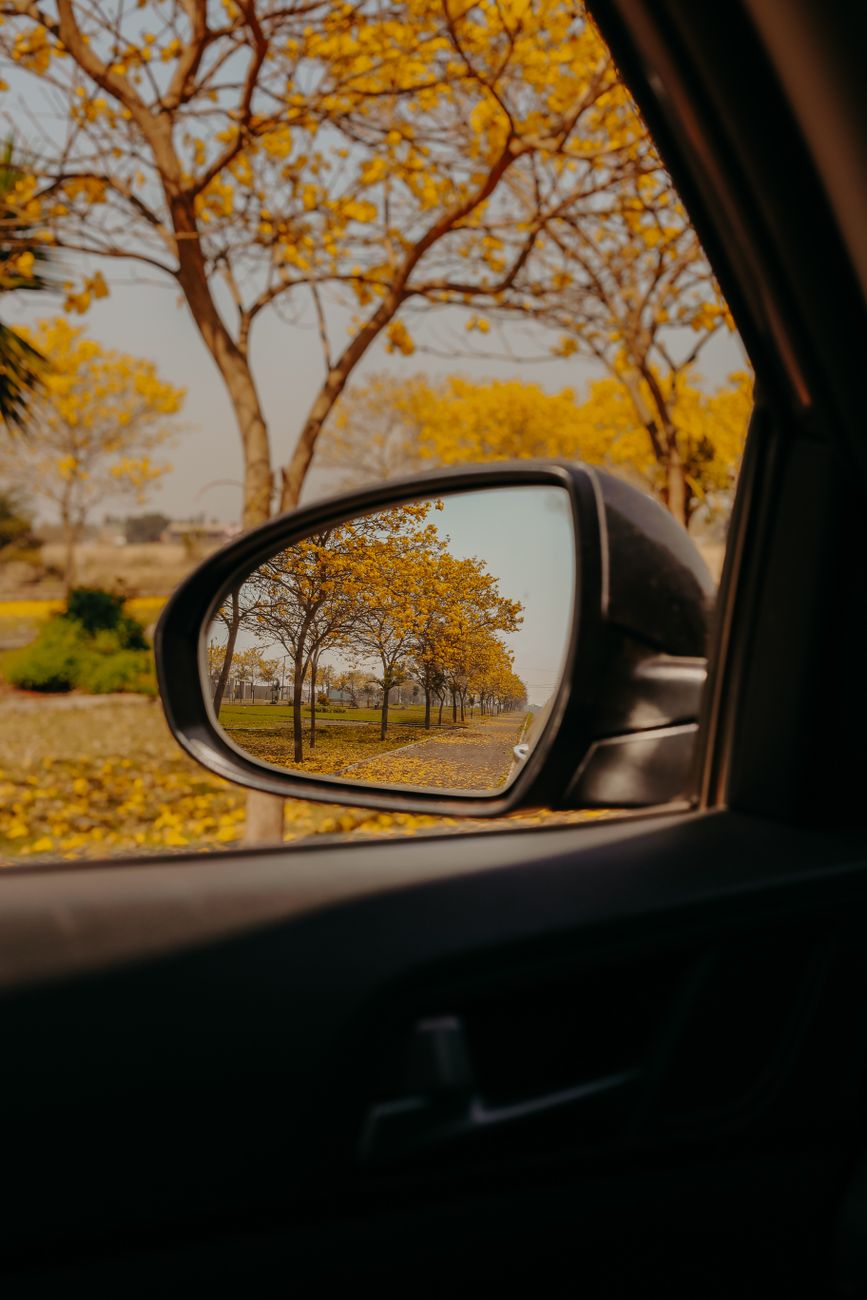
Before driving, sit correctly in the driver's seat. Adjust the interior rearview mirror so you see the entire rear window. For side mirrors, the DGT and Guardia Civil recommendation is clear: they should be adjusted so that "they do not reflect any part of the vehicle itself." This means tilting the mirror outward until you lose sight of the body. Although it may feel uncomfortable at first, this adjustment maximizes the field of view and significantly reduces blind spots.
Step 2: Review Frequency: Every 5 to 8 Seconds
While driving, establish a constant rhythm of mirror checks. The recommended frequency is every 5 to 8 seconds. Do not wait until you need to perform a maneuver; check mirrors even when driving straight. This habit allows you to anticipate risky situations, such as vehicles approaching rapidly from behind or drivers changing lanes without signaling.
Step 3: Manage Blind Spots by Turning Your Head Slightly
No mirror completely eliminates blind spots. To reduce them, turn your head slightly before changing lanes or merging. The DGT recommends "monitoring blind spots by turning your head slightly." Do not rely solely on mirrors; a quick 45-degree turn can reveal a vehicle in the blind spot. If your vehicle has electronic assists (like blind spot warning), use them as support, but not as a substitute for direct visual observation.
Step 4: Application in Specific Maneuvers
Each maneuver requires a different mirror sequence. Here are the most common:
- Left lane change: Check interior mirror, then left mirror, and turn your head to verify the left blind spot. Signal and execute the change.
- Right lane change: Check interior, right mirror, and right blind spot. On two-way roads, also pay attention to the front, as other vehicles may be overtaking.
- Merging onto a road: Observe the side and interior mirrors on the side you are merging toward, turn your head to check blind spots, and adjust speed to insert into a safe gap.
- Overtaking: According to the DGT, when overtaking you must "observe forward (vital on two-way roads) and backward through the interior and left mirrors. Return to the right when you see the overtaken vehicle in the right and interior mirrors."
- Roundabouts: When driving in the outer lane, monitor the left mirror. If a driver tries to cut across from the inside (illegally), you can anticipate a collision.
How to Apply the Framework
- Before the test: Practice mirror adjustment in a parked vehicle. Adjust the side mirrors until the vehicle body disappears from view. Sit in the position you will use during the test and verify that mirrors are correctly oriented.
- During practice driving: Use a timer to verify you check mirrors every 5-8 seconds. At first it may feel artificial, but it will become automatic. Associate checking with reference points: for example, every time you pass a lamppost or traffic sign, check the mirrors.
- On test day: The examiner will watch if your eye movements are systematic. Do not forget to turn your head for blind spots; doing it only with your eyes may not be enough.
Examples and Case Studies
Case 1: Lane change on the highway
María is taking her practical test. She is driving in the right lane at 80 km/h and needs to move to the center lane. She applies the framework: checks interior mirror (sees a car in the distance), then left mirror (the car is not yet in her blind spot), turns her head left (confirms no one in the blind spot). Signals, waits 3 seconds, and changes lanes smoothly. The examiner notes "correct mirror use."
Case 2: Entering a roundabout
Juan approaches a roundabout. According to step 4, he checks interior and right mirrors, turns his head right to verify the blind spot. Seeing no vehicles, he enters. While driving in the outer lane, he maintains checks every 5 seconds. He notices through the left mirror that a vehicle in the inner lane activates its right turn signal (indicating it will exit), but Juan continues monitoring in case the other driver changes their mind. This anticipation prevents a potential scrape.
Common Mistakes to Avoid
- Checking mirrors too frequently or for too long: Glances should be brief, no more than 1-2 seconds. If you fix your eyes on the mirror, you lose forward reference. Practice quick "sweeps."
- Adjusting side mirrors to see the vehicle body: This is a very common mistake. Following the DGT recommendation not to see the vehicle body may seem odd, but it is safer.
- Not turning your head for blind spots: Many test takers rely only on mirrors. Remember that mirrors do not cover everything; head turns are mandatory.
- Checking mirrors only before maneuvering: Checks must be constant, not only when changing lanes. A driver who does not check periodically can be surprised by a rapidly approaching vehicle.
- Forgetting mirrors in roundabouts: Roundabouts are critical points. The DGT warns that if you drive in the outer lane, you must monitor the left mirror to anticipate drivers cutting across from the inside.
Templates and Tools
Daily Practice Template
| Day | Initial adjustment (yes/no) | Every 5-8 sec frequency (yes/no) | Head turn for lane changes (yes/no) | Maneuvers practiced | Instructor notes |
|---|---|---|---|---|---|
| Monday | |||||
| Tuesday |
Pre-test Checklist
- Seat adjusted, good posture
- Interior mirror: see whole rear window
- Left mirror: no vehicle body visible
- Right mirror: no vehicle body visible
- I know the 5-8 second frequency
- I remember to turn my head for blind spots
- I know the mirror sequence for each maneuver
Relationship with Other Skills
Correct mirror use is closely linked to the ability to react to unexpected events. Frequent checking allows you to detect risky situations (like a vehicle braking hard behind you) in advance. To delve deeper into how to apply this information in unexpected situations, see our guide on Evaluating the ability to react to unexpected events during the practical test.
Additionally, mastering mirror use is essential to pass the test. If you want to know the most common errors in this area and how to correct them, read our article on How to correct mirror use errors during the practical test (note: the link will direct to the corresponding article; make sure to replace with the correct slug according to the provided list).
Conclusion
The 4-point method—initial adjustment, constant frequency, blind spot management with head turns, and specific sequence per maneuver—provides a clear structure for using rearview mirrors professionally during your driving test. Practice these steps until they become automatic habits. Remember that checking every 5 to 8 seconds is not optional but a safety requirement that examiners rigorously evaluate. Combine this technique with proper anticipation of traffic situations, and not only will you pass the test, but you will become a safer driver.